Layering a Balanced Container Soil: A Step-by-Step Method with Variations and Troubleshooting
Why layer a container soil?
Layering is not about creating separate, impermeable strata but about arranging materials so each contributes to drainage, aeration, moisture retention and slow-release fertility. For small containers, a thoughtful assembly avoids common problems—waterlogging, compacted soil, and rapid nutrient loss—while keeping the method simple enough for a kitchen windowsill or narrow balcony.
Step-by-step method
-
Choose the right container.
Select a pot with drainage holes. Example: a 20 cm (8 in) terracotta pot works well for a 3–4 stem basil or a small parsley clump; a 30 cm (12 in) plastic pot suits a dwarf tomato or mixed herb trial.
-
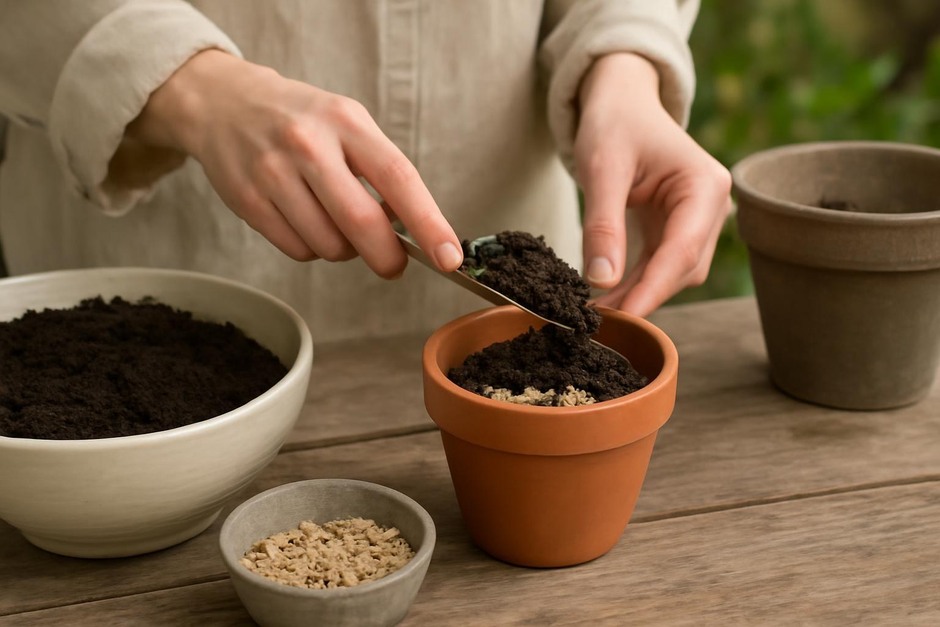
Create a base for unobstructed drainage (1–2 cm / 0.5–1 in).
Place a thin layer of coarse material—crushed terracotta, pebbles, or coarse perlite. This prevents fine particles from clogging the outlet and reduces water sitting directly at the holes.
-
Add a transitional grit layer (1–2 cm).
Use coarse sand or small gravel. This intermediary layer slows the downward movement of fines from the mix above while maintaining hydraulic conductivity. In very small pots you can skip this step and instead ensure the potting mix is coarse enough.
-
Mix your main potting blend (fill to within 3–5 cm / 1–2 in of the rim).
A reliable blend: 50% good-quality compost/leaf mold, 30% coarse horticultural grit or perlite, 20% local garden soil or aged composted bark. For a 5 L (about 1.3 gallon) herb pot, mix about 2.5 L compost, 1.5 L grit/perlite, 1 L soil/bark. The compost supplies nutrients and water-holding capacity; the grit/perlite keeps pore space and lightness.
-
Top-dress and anchor plants (final 2–3 cm).
Add a thin layer of fine compost or worm castings as a starter nutrient band. Plant seedlings gently, firming the mix around roots but avoiding compaction.
-
Water in and observe.
Water slowly until excess flows from the drainage holes. Watch how quickly the water drains the first time and adjust future water amounts. For example, if water pours through in seconds, the mix may be too coarse; if it pools, add more grit or perlite next time.
Small examples to connect principle with practice
-
Windowsill herb pot (3 L):
Base: 1 cm pebble, Transition: skip; Main mix: 1.5 L compost, 0.9 L perlite, 0.6 L aged bark; Top-dress: tablespoon worm castings.
-
Patio tomato pot (20 L):
Base: 2 cm crushed terracotta, Transition: 1 cm grit; Main mix: 10 L compost, 6 L coarse sand/perlite, 4 L garden loam; Top-dress: 2 handfuls of compost.
Variations
-
Succulent and cactus variation:
Increase grit/perlite to 60–70% and reduce compost to 10–20%. Use no fine garden soil. This ensures very fast drainage and low moisture retention.
-
Long-term edible pots (tomatoes, peppers):
Include a 10–15% fraction of slow-release organic matter like well-rotted composted manure and plan for mid-season top-dressing of compost and light feeding with compost tea or diluted organic liquid feed.
-
Container for cut-and-come-again salad leaves:
Use a higher-proportion compost blend (60%) to keep rapid growth and regular harvests, and refresh the top 2–3 cm each month to maintain fertility.
Troubleshooting
Problem: Soil stays waterlogged and roots smell musty
Cause: Poor drainage or too much fine material. Solution: Repot into a coarser mix. Remove the plant if possible, shake off saturated soil, trim rotted roots, and replant in a blend with at least 30% coarse perlite or grit. Ensure drainage holes are clear.
Problem: Soil dries out within a day after watering
Cause: Mix too coarse or pot too shallow relative to plant size. Solution: Increase compost/organic fraction slightly, or use a pot with greater volume. Mulching the surface with fine bark or a thin gravel layer slows evaporation.
Problem: Slow growth and pale leaves
Cause: Low available nutrients. Solution: Top-dress with compost or a small dose of balanced organic fertilizer. For edible containers, reapply compost monthly or add a measured organic liquid feed.
Problem: Mix compacts over the season
Cause: Breakdown of organic particles and repeated watering. Solution: Each season lift a portion of the top 3–5 cm and refresh with fresh compost and grit. When repotting annually, replace a third to half of the old mix.
Layering is a deliberate, adaptable way to give containers the structural and nutritional environment plants need. Start small, observe how your chosen plants respond, and make small adjustments—each pot becomes a tiny experiment that teaches the principle behind what works.